High-Performance Computing Center Stuttgart


The impulse to collaborate has been embedded in the DNA of the High-Performance Computing Center Stuttgart (HLRS) since its beginnings. As a national supercomputing center and member of the Gauss Centre for Supercomputing, it coordinates extensively with the Jülich Supercomputing Centre and Leibniz Supercomputing Centre to provide German and European researchers access to world-class HPC capabilities. HLRS is also involved in dozens of collaborative HPC-related research projects, and has organized Solution Centers that offer a precompetitive forum in which players in strategic industries develop solutions for shared problems. In addition, HLRS works closely with other European HPC centers and international partners from across the global supercomputing community, cultivating relationships that facilitate the exchange of new ideas for improving performance, efficiency, and usability. Focusing on infrastructure, training, and research, these activities foster innovation.
"Ultimately, HLRS collaborates with other HPC centers because it enables us to provide the best possible portfolio of resources and services — locally, nationally, and across Europe," says Prof. Michael Resch, Director of HLRS. "From systems, to support, to training, to research, our partnerships ensure that HPC users in Europe benefit from the knowledge we collect, and that HLRS implements the best available ideas from across the international HPC community."
With several major universities and a diverse landscape for higher education in technical disciplines, science in the state of Baden-Württemberg has long relied on access to HPC resources. For many years, institutions across the state have collaborated within the Working Group of the Scientific Leaders of Computing Centers in Baden-Württemberg (ALWR) to optimize the usage, accessibility, and impact of digital resources and expertise. This effort traces its origins to the early 1990s but gained momentum in 2008 with the bwGRID initiative, which set out to construct a statewide federated computing infrastructure. At that time, HLRS raised federal funds for needed hardware, while the state of Baden-Württemberg provided financial support for staff and development.
Around 2013, this effort evolved into bwHPC, the first ever statewide concept for coordinated management of high-performance computing resources and expertise in Germany. bwHPC implemented a strategic, multi-tiered approach in which academic data centers were classified based on their capabilities for peak performance and scalability. This collaboration had the benefit of reducing competition for available financial resources. At the same time, it has guided students and researchers across Baden-Württemberg to computing resources that best meet their needs, from general purpose computing to extreme scale supercomputers located at HLRS. Over the years, bwHPC has continued to evolve, establishing an integrated data management platform for moving data between computing centers and systems, as well as specialized competence centers and coordinated programs for continuing education.
Currently, bwHPC coordinates access to five bwHPC clusters, which provide general computing capabilities for university students and researchers from specific scientific user communities. For users who require access to highly parallelized supercomputing systems for computationally intensive operations, the Karlsruhe Institute of Technology (KIT) operates HOREKA, a tier-2 system within the bwHPC framework. HLRS's Hunter supercomputer currently serves as the tier 0/1 HPC system within the bwHPC consortium, providing capabilities for the most demanding applications of advanced computational research. Organizing computing capabilities in this way offers a unified framework within which users can scale their knowledge and codes from small clusters up to high-performance systems as their research and computational needs grow.
Organizing things in this way also connects scientists in Baden-Württemberg to the national and international high-performance computing communities. KIT's Scientific Computing Center participates in the national high-performance computing network (NHR), while HLRS connects research in Baden-Württemberg to the formidable computing resources of the Gauss Centre for Supercomputing. This ensures that there is a constant flow of knowledge concerning the latest HPC technologies and methods across the bwHPC network. The approach extends to skills development for HPC users, as HLRS's training program is accessible from across bwHPC, linking regional, national, and international programs for continuing professional education.
Since its founding in 2018 the EuroHPC Joint Undertaking (JU) has implemented a coordinated strategy aimed at improving Europe's global competitiveness in simulation, artificial intelligence, and quantum computing. Operating on the principle that Europe becomes stronger when its member states cooperate rather than compete with one another, the JU has overseen installation of powerful computing systems across the EU, established a network of AI Factories and AI Factory Antennae, and supports a broad portfolio of training initiatives to promote HPC skills development. Such efforts have helped drive Europe's ongoing efforts to reduce reliance on offshore, private service providers for HPC and AI.
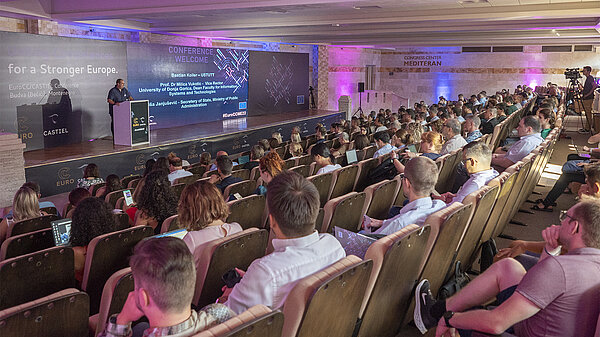
Two projects coordinated by HLRS, called EuroCC and CASTIEL, have played important roles in promoting these goals. Now in their third phase, these projects led the organization of a network of JU National Competence Centers (NCCs) and Centers of Excellence across 33 European countries. By gathering and facilitating the sharing of HPC competencies contained across the NCC's, the overall European level of expertise has risen collectively. Because each NCC now serves as a key contact point for academic and industrial scientists looking for HPC expertise and computing capabilities, the EuroCC network also ensures that regardless of where HPC users in Europe are located, they can access the same kinds of high-quality resources.
"Applying to coordinate EuroCC and CASTIEL was a strategic decision," says Dr. Bastian Koller, Managing Director at HLRS and leader of the EuroCC and CASTIEL initiatives. "It was clear that there would always be other European HPC centers beside HLRS with larger supercomputers, and just having just the fastest system in Europe was never our primary goal. By coordinating these projects for the EuroHPC Joint Undertaking, we have instead tried to be a central partner in helping to bring together the enormous knowledge base that exists across the EU. This has helped us in Germany, as we have learned a great deal from what HPC centers elsewhere are doing, and at the same time the growing list of success stories across the NCCs shows that this effort is having a great impact across Europe."
HLRS also coordinated the creation of the HPC in Europe Portal, a website launched in 2025 that serves as a one-stop access point for HPC users in science and industry who are looking for HPC service providers, training opportunities, and other resources. Moreover, the Stuttgart center is bringing its longstanding expertise in HPC training into projects like EVITA and HPC SPECTRA, which are improving access to up-to-date training curricula for HPC users across Europe.
Although they operate under different political, economic, and social conditions, HPC centers around the world face many of the same kinds of challenges. Performance optimization, energy efficiency, workforce training, and the imperative to translate computing capabilities into practical applications that improve society, for example, are issues with which HPC centers everywhere must contend. Although often carried out in response to local conditions, HPC research that takes place in one region can often provide inspiration for similar approaches in other regions. International cooperation can help to accelerate the diffusion of these ideas. At the same time, maintaining scientific contacts internationally can also have political benefits, establishing informal channels that improve intercultural understanding and promote friendship and solidarity across borders.
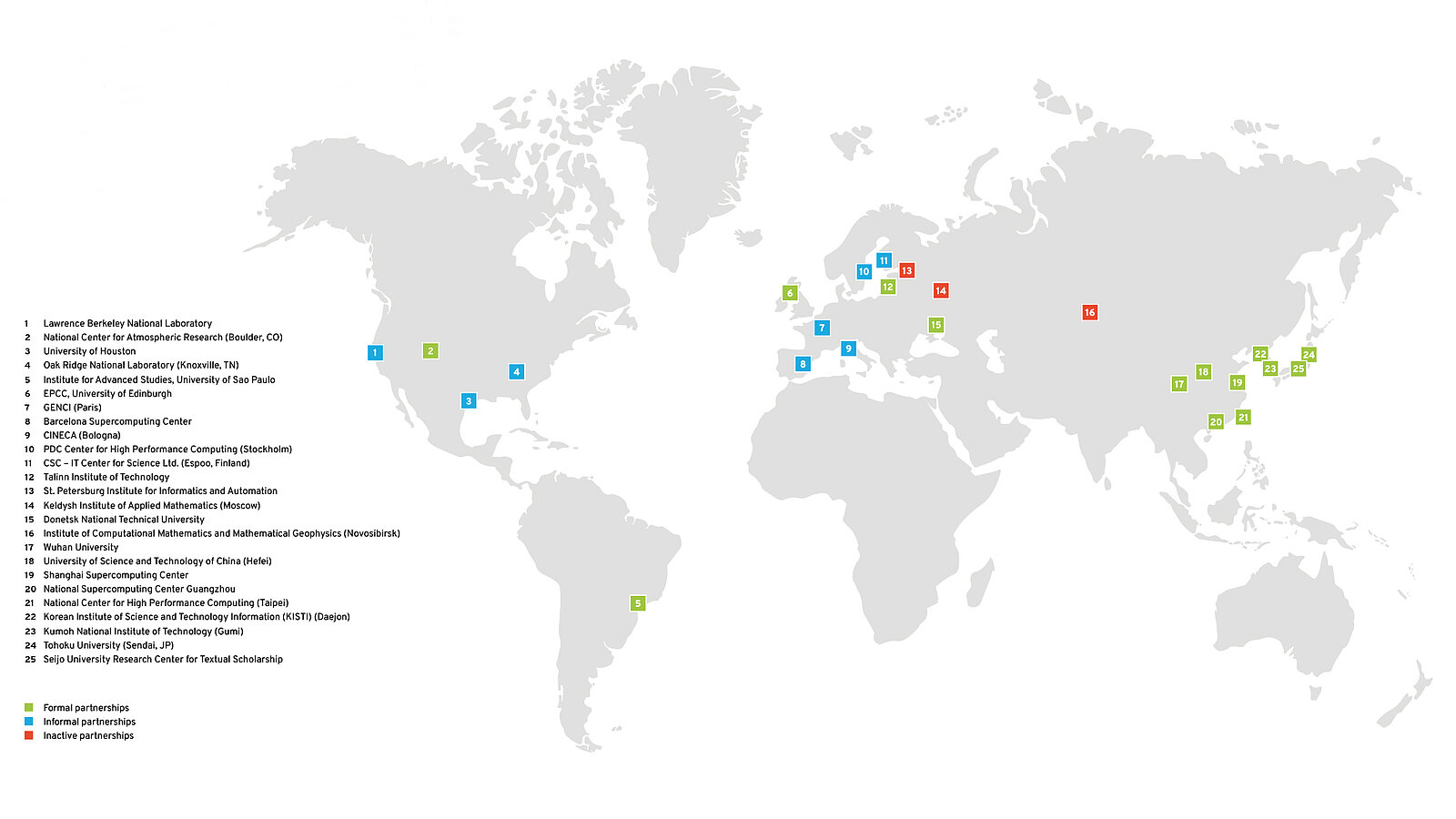
HLRS has for many years pursued active and productive partnerships with leading academic and research institutions across the world. The center currently maintains 13 formal memoranda of understanding with HPC centers and academic institutes across Europe, Asia, and the Americas, in addition to many additional informal partnerships (see map). Focusing on HPC-related topics of mutual interest, the partnerships have supported collaborative research, staff exchange, workshops, education programs, and industrial outreach.
One of HLRS's closest and longest running international collaborations has been with the computer science department at Tohoku University in Sendai, Japan. The partnership started in 2004 because Tohoku and HLRS were both operating high-performance vector computing systems manufactured by NEC. At that time, some said that vector architectures had become outdated, but HLRS and Tohoku agreed that they remained very effective in providing the sustained performance their specific user communities required. Since then, scientists from HLRS and Tohoku have typically met twice each year for the Workshop on Sustained Simulation Performance. Although the technologies in the centers' more recent supercomputers have evolved beyond vector architectures, the regular dialogue has enabled both centers to gain new insights into how to maximize performance in modern HPC systems. An annual book series documents the results of these meetings for the wider HPC community.
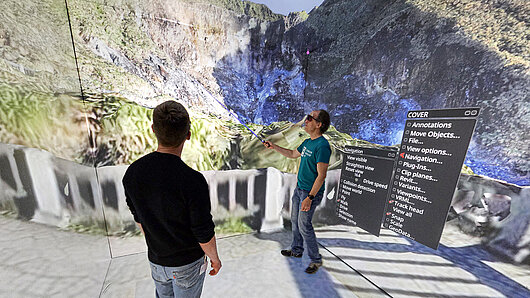
Growing out of a collaboration that started in 1999, scientists at HLRS have also recently been working with investigators at the Taiwan National Center for High-Performance Computing in Taipei (NCHC). In 2025, Visualization Department head Dr. Uwe Wössner traveled with NCHC scientists to Yangmingshan National Park, a nature preserve located north of Tapiei on a dramatic landscape shaped by volcanic activity. With 3D scans using multi-spectral image sensors and photogrammetry, the researchers created a digital twin of the park that can now be studied in HLRS's CAVE virtual reality facility. The high-resolution scans make it possible to distinguish among plant types, and the researchers plan to train a machine learning algorithm to recognize vegetation and landscape features. As the project progresses, they intend to integrate geologic and other data in ways that will enable park managment to better predict and understand the effects of wildfires, landslides, and earthquakes. For HLRS, the expertise that it will gain will be a valuable resource for future digital twin projects back in Germany.
Ultimately, high-performance computing exists to help solve complex problems facing scientific research, industrial innovation, and society. Computing power alone, however, will never be enough to achieve these goals. Considering how exascale computing, artificial intelligence, quantum computing, and other future computing technologies are currently transforming HPC, resource coordination, collaborative research, and knowledge sharing will continue to be essential elements of HLRS's activity. Working closely with the wider HPC community will help the center to ensure that technological advantages produce the greatest societal impacts, new computing paradigms are adopted and operated in a sustainable way, and HLRS's user community derives the greatest benefits for its future research.
— Christopher Williams

A member of the Gauss Centre for Supercomputing, HLRS is one of three German national centers for high-performance computing.
