High-Performance Computing Center Stuttgart


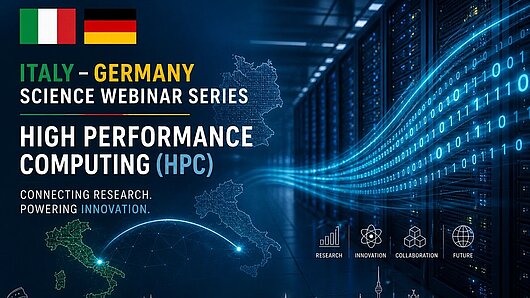
In May-July 2026, the International Relations Office of the National Research Council of Italy (CNR), with the support of the science attachè office of the Italian Embassy in Berlin and of the High-Performance Computing Center Stuttgart, presents an eight-part webinar series on high-performance computing. The event is conceived for researchers at Italian and German partner institutions aimed at strengthening bilateral scientific cooperation. The goal of the series is to demystify the "black box" of supercomputing by providing a structured overview. After beginning with foundational concepts, the series will explore the state of the art in HPC technologies, domain applications, and strategic outlooks.
Whether you are already utilizing computational tools and looking to optimize and scale your existing workflows, or a researcher seeking a better understanding of how these advanced technologies will define the future standards and possibilities of your field, these webinars will provide the necessary framework to navigate the world of large-scale computation. We invite you to join us in exploring how HPC can serve as a gateway for your next scientific breakthrough.
Attendance for all webinars is free, but registration is required. Please see the program below and follow the links to register.
(All events 10:00 - 12:00 CET)
May 12, 2026
A History of Supercomputing: From Early Machines to Exascale
Massimo Bernaschi (Institute for Applications of Calculus “Mauro Picone”)
A journey through the milestones of HPC, tracing the evolution from the first vector processors to modern parallel architectures.
The Role of HPC in Modern Science: Simulation and Modeling
Michael Resch (High-Performance Computing Center Stuttgart)
An exploration of how supercomputing has become a fundamental pillar of research, transforming scientific verification through precise numerical worlds.
May 20, 2026
The Physical Infrastructure of HPC: Managing Large-Scale Systems
Herbert Huber (Leibiniz Supercomputing Centre)
An insight into the physical requirements and logistical challenges involved in maintaining and operating large-scale supercomputing facilities.
Architecture and Design: The European Processor Initiative (EPI)
Mauro Olivieri (Sapienza University of Rome and National Research Council of Italy)
The technological roadmap for developing independent European chip architectures to ensure high performance and technological sovereignty.
Neuromorphic Computing: Brain-inspired Hardware Architectures
Abigail Morrison (Institute of Advanced Simulation, Forschungszentrum Jülich, Helmholtz Association and RWTH Aachen University)
An exploration of specialized hardware designed to mimic neural structures, focusing on high-efficiency processing and energy reduction.
May 27, 2026
Scalable Numerical Algorithms for Parallel Architectures
Pasqua D’Ambra (Institute for Applied Computing "Mauro Picone")
An overview of mathematical algorithms designed to efficiently divide large-scale problems across millions of synchronized processing units.
Software Environments and Interoperability in HPC
Dieter Kranzlmüller (Leibniz Supercomputing Centre)
The importance of robust software layers that allow researchers to utilize diverse hardware infrastructures without extensive code modification.
User Interfaces and Accessibility in Supercomputing
Lorenzo Zanon (High-Performance Computing Center Stuttgart)
Methods and tools designed to simplify the interaction between scientists and HPC systems, broadening the reach of supercomputing.
June 3, 2026
Computational Material Science: Modeling at the Atomic Scale
Stefan Blügel (Peter Grünberg Institute at Forschungszentrum Jülich – Helmholtz Association and RWTH Aachen University)
How quantum mechanics and HPC are used to predict material properties prior to physical synthesis, accelerating research cycles.
Numerical Simulation for Nanotechnology and Electronics
Arrigo Calzolari (Nanoscience Institute, National Research Council of Italy)
A study on how nanotechnologies rely on numerical simulations to develop more efficient and resilient electronic devices.
AI and HPC Integration for Material Discovery
Silvana Botti (Research Center for Future Energy Materials and Systems and Ruhr University Bochum)
The use of artificial intelligence combined with massive calculation to identify optimal chemical combinations for future energy solutions.
June 11, 2026
Virtual Prototyping and Industrial HPC Workflows
Bastian Koller (High-Performance Computing Center Stuttgart)
How HPC is integrated into industrial engineering to test prototypes under extreme conditions, reducing development costs.
Computational Fluid Dynamics: Simulating Complex Airflows
Matthias Meinke (RWTH Aachen University)
An overview of the challenges in CFD, where massive parallel calculation is used to visualize and optimize aerodynamic flows.
HPC in Marine Engineering: Ship Design and Propulsion
Stefano Zaghi (Institute for Applied Computing "Mauro Picone", National Research Council of Italy)
Using numerical simulation to optimize hull efficiency by studying the interaction between solid structures and marine environments.
June 17, 2026
Genomic Data Analysis and Personalized Medicine
Benedikt Brors (German Cancer Research Center, Helmholtz Association)
The application of supercomputing in analyzing vast genetic datasets to improve diagnostic accuracy and identify targeted therapies.
Molecular Dynamics and Computational Drug Discovery
Andrea Cavalli (University of Bologna and Italian Institute of Technology)
Simulating molecular interactions to predict the efficacy of new pharmacological compounds within the human body.
Computational Neuroscience: Modeling Neural Systems
Michela Fagiolini (Institute of Neuroscience, National Research Council of Italy, Boston Children's Hospital, Harvard Medical School)
The use of mathematical models to decipher complex neural signals and gain insights into brain development and disorders.
June 24, 2026
High-Resolution Climate Modeling and Atmospheric Dynamics
Bjorn Stevens (Max Planck Institute for Meteorology)
Utilizing high-resolution simulations to better understand the Earth's energy balance and the role of cloud systems in climate change.
Modeling Coastal and Marine Ecosystems
Corinna Schrum (Institute of Coastal Systems at Helmholtz-Zentrum Hereon and University of Hamburg)
Investigating the evolution of marine environments in response to climate change through models connecting physical and ecological dynamics.
HPC and Satellite Data for Hydrological Prediction
Luca Brocca (Research Institute for Geo-Hydrological Protection, National Research Council of Italy)
The integration of real-time satellite observations and HPC to predict extreme hydrological events and improve disaster management.
July 1, 2026
Sanzio Bassini (International Foundation Big Data and Artificial Intelligence for Human Development, National Center for HPC, Big Data and Quantum Computing)
Carlo Cavazzoni (Leonardo)
Martin Frank (Steinbuch Centre for Computing at Karlsruhe Institute of Technology, Helmholtz Association)
Elisa Molinari (Nanoscience Institute, National Research Council of Italy, University of Modena and Reggio Emilia)
Michael Resch (High-Performance Computing Center Stuttgart)
Anita Schöbel (Fraunhofer Institute for Industrial Mathematics) - to be confirmed

A member of the Gauss Centre for Supercomputing, HLRS is one of three German national centers for high-performance computing.
