High-Performance Computing Center Stuttgart


In the coming years, however, experts anticipate that the steady performance gains we have come to expect under Moore's Law will stagnate. Microchip fabrication can now be done on the astonishing scale of 2 nanometers, meaning that miniaturization is approaching its physical limits. And although it would be possible to build faster GPUs, this will only be commercially viable by pricing them more expensively, making large-scale systems for high-performance computing (HPC) increasingly unaffordable.
As a result, the computer engineering community continues to innovate. In parallel with the rise of GPUs, hardware companies large and small have been developing promising new paradigms that are either fundamentally different than those behind traditional CPU-based and GPU-accelerated systems, or that build on the basis of more established architectures in new ways. Although many of these approaches have not yet fully matured, they hold the potential to solve at least certain kinds of computational problems faster and using much less energy than even today’s best supercomputers.
As HPC centers like the High-Performance Computing Center Stuttgart (HLRS) look towards the next generation of supercomputing, determining which of these new technologies to adopt, and when, is extremely important. This is because investing in a new technology is not purely a financial decision, but can lock a center into a specific technological trajectory that will determine its relevance as HPC continues to evolve.
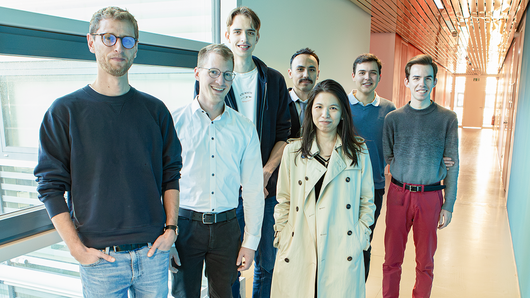
Recently, HLRS launched a new initiative called the Future Computing Group to explore which emerging technologies for high-performance computing hold the greatest potential to address the needs of HLRS's scientific and industrial user communities. Working closely with technology companies, the group will also provide HPC expertise that will support industrial research on next-generation computing hardware.
According to Future Computing Group leader Dr. Johannes Gebert, "We are open to collaborating with companies and to evaluate their computer paradigms. For example, we need to understand whether the hardware can solve the kinds of problems our user community has. This means answering many questions. Is the new hardware relevant for certain algorithms and software packages? And do the advantages that it might offer outweigh those of other, more established technologies and companies?" As computing architectures become more heterogeneous, the Future Computing Group will help evaluate which technology combination best meets HLRS's needs.
HLRS is scheduled to install its next supercomputer, called Herder, in 2027. Like other world-class supercomputers, Herder will use GPU accelerators. What comes after Herder, however, is still an open question, and will in many ways depend on how high-performance computing hardware and user demands evolve in the coming years.
As the supercomputing community anticipates a future in which performance gains result not exclusively from the use of GPUs, one potential addition to the portfolio of HPC technologies is quantum computing. Modest quantum systems based on a variety of architectures are already in operation, and as research continues, it is possible that more than a single architecture could prove to be reliable, versatile, and easy to use in everyday practice. Another emerging technology is neuromorphic computing, whose architecture is inspired by the human brain. This approach promises to calculate at similar speeds to those of today’s fastest systems while using a small fraction of the energy. Practical implementation of neuro-inspired computing in HPC settings is still some time away, though. Meanwhile, a variety of other interesting, if less radical, technologies are under development with the goal of achieving performance and efficiency breakthroughs using more traditional architectures.
In the coming years, HLRS’s Future Computing Group will evaluate the maturity of such architectures, research the performance of algorithms on these technologies, and develop software. By publishing the results of this work, the group will support scientific and industrial communities in benefiting from post-Moore hardware.
In November 2025 the Future Computing Group launched the first of what Gebert anticipates will be a number of technology evaluation partnerships. HLRS has begun collaborating with Openchip, an international company founded and headquartered in Barcelona that focuses on the design and development of high-performance accelerator chips, platforms, and software stacks for advanced computing applications, based on the global RISC-V architecture standard. Using an approach to acceleration that leverages vector processing in a new way, Openchip’s system-on-a-chip solutions promise to offer a "designed in Europe" technology that is optimized for high-performance computing, delivering greater sustainability and productivity without the complexities of porting codes to GPUs. Considered an Important Project of Common European Interest (IPCEI), Openchip seeks to advance Europe’s overall digital sovereignty.
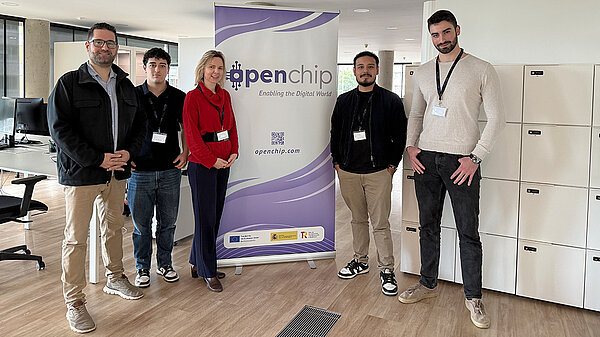
"Even the best technology is useless if no one wants to buy it or use it; ensuring that our product is competitive and truly satisfies users’ needs is therefore critical," says Ivan Rodero, Chief Innovation Officer at Openchip. "We are working with HLRS and other centers to better understand what HPC facilities need from the hardware. By examining a wide spectrum of applications, we aim to clarify their requirements and ensure that applications can run efficiently on RISC-V. HLRS's Future Computing Group makes this collaboration much smoother and gives us the opportunity to drive real innovation — something that is not always easy."
The collaboration with Openchip is just an early step for the Future Computing Group. Gebert anticipates that several additional collaborations with technology startups will launch in the coming months.
The Future Computing Group aims to support the community surrounding emerging HPC technologies by promoting the exchange of new insights. In January 2026, it is organizing a "birds of a feather" session at SCAsia, the largest meeting of the Asian high-performance computing community. On March 16-17, 2026, HLRS will also host the Future Computing Workshop in Stuttgart, bringing hardware vendors, research software developers, and domain-specific researchers together to discuss the current status of high-performance computing architectures, and the potential of emerging computing paradigms.
As Gebert explains, HLRS has an important role to play in bridging the gap between technology companies and the scientists whose research their next-generation products will benefit: "HLRS has a lot of experience supporting computational research, and we know that researchers have clear ideas about what kinds of questions they could ask with access to much faster HPC systems. In the Future Computing Group, our goal is to identify the infrastructure that will best support the development of the algorithms, software, and heterogeneous computing workflows that will take scientific computing to a new stage."
— Christopher Williams

A member of the Gauss Centre for Supercomputing, HLRS is one of three German national centers for high-performance computing.
