High-Performance Computing Center Stuttgart


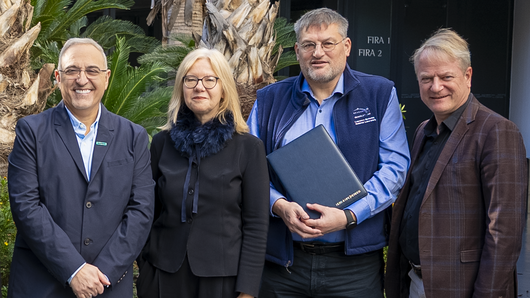
Prof. Michael Resch, Director of HLRS, celebrated the announcement, saying, "Herder will offer HLRS's scientific and industrial user communities state-of-the-art technologies for both high-performance simulation and artificial intelligence. Combining these capabilities on a single system will also support some of today's most exciting computational research, which is bringing numerical simulation and AI together in extremely interesting ways. Herder will enable our users to simulate systems at a degree of precision and at a scale that is unprecedented in Stuttgart, while also offering local, sovereign capacity for AI model training and generative AI. We are excited about the kinds of results that it will make possible."
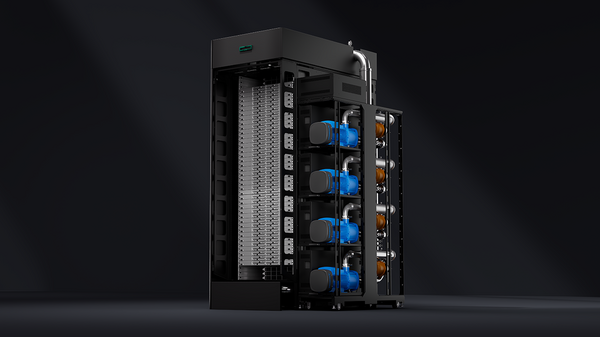
Herder will be based on the HPE Cray Supercomputing GX5000 system. Announced by HPE in November 2025, it is designed to support the large-scale numerical simulations that are essential within HLRS's traditional user communities, as well as data-science approaches for AI model training and generative AI. Bringing these capabilities together within a single system enables the development of new kinds of converged computing workflows that seamlessly integrate the two approaches.
Herder will incorporate the HPE Supercomputing Management Software, which supports the containerized methods needed for HPC/AI workflows. The new supercomputer will use the Lustre-based HPE Cray Supercomputing Storage Systems E2000 to alleviate bottlenecks in the management of large datasets and improve overall system performance. HPE Slingshot 400 switches will move data across the system at high speeds and with low latency.
Delivery of Herder is scheduled for the second half of 2027 and it is expected to go into service by the end of 2027. Herder will replace HLRS's current flagship supercomputer, called Hunter.
When it arrives, Herder will be in good company among the world's most advanced high-performance computing systems. HPE Cray Supercomputing GX5000 is the same platform being used in the upcoming Discovery, Mission, and Vision supercomputers in the United States and the Blue Lion system at Leibniz Supercomputing Centre near Munich.
Herder will contain next-generation processors from AMD, including the AMD Instinct™ MI430X GPU and AMD EPYC™ “Venice” CPU. Each MI430X supports 432GB of HBM4 memory and 19.6TB/s of memory bandwidth, offering powerful capabilities for data-intensive operations in both HPC and AI. The Venice CPU is the world's first processor to use TSMC's (Taiwan Semiconductor Manufacturing Company's) 2-nanometer fabrication methods, which make it possible to pack more transistors onto each computer chip than was possible in the past. By bringing the transistors closer together, information can be moved through the system more quickly.
The increased memory and communications density that these processors offer in comparison to current technologies will accelerate performance to new heights. HLRS anticipates that Herder will achieve a peak performance of more than seven times the capabilities of Hunter.
This jump in performance means that Herder will use substantially more power than Hunter, and so energy efficiency and sustainability have been key considerations in its planning. The system will be housed in a new data center that is currently under construction at HLRS and has been designed with sustainability in mind. The building, called HLRS III, will be accompanied by a new energy facility that will process Herder's waste heat for reuse in the campus’ district heating network. The heat will be distributed to other buildings on the University of Stuttgart's Vaihingen campus. This will help reduce the University's heating costs and cover its process heat needs, making a significant contribution to its decarbonization efforts.
The HPE Cray Supercomputing GX5000 integrates several technologies to maximize energy efficiency. It uses direct liquid cooling, a feature that efficiently removes heat from the system and is critical for the reliable operation of the dense AMD MI430X and Venice processors. Working together with HPE, HLRS also plans to implement a dynamic power management approach called Powersched on the new system. HLRS received an Environmental Management Prize in November 2025 for its collaboration with HPE on the development and testing of this approach, which automatically regulates the distribution of power to each of a supercomputer's nodes based on the applications running on them.
Herder will be used for research across a wide range of disciplines, including computational engineering, physics, chemistry, climate science, and biomedicine. It will power advances in basic science, enable industry to develop better products, and support the public sector in efforts to address global challenges.
— Christopher Williams
Funding for Herder is provided by the German Federal Ministry of Research, Technology and Space through the Gauss Centre for Supercomputing, and the Baden-Württemberg Ministry for Science, Research and Arts.
"Ever since the installation of the first high-performance computers in Stuttgart and Karlsruhe in the 1980s, we have been pursuing a clear strategy for high-performance computing at the state level. In the future our new supercomputer will open unexpected dimensions of performance. Herder will strengthen HLRS as a central node of the HPC ecosystem in Baden-Württemberg and at the national level. This investment shows a clear commitment. As a state we consciously create the best conditions for technological and scientific excellence — in the field of high-performance computing we don't want to just keep up, but to lead the way."
“Herder is a crucial component of a supercomputing infrastructure in Stuttgart that will simultaneously be powerful, efficient, and resource-conserving. It is not only our top researchers who will benefit, but also the entire innovation ecosystem of our university.”
“HLRS has a unique mission in Germany’s national supercomputing landscape in that it enables cutting-edge scientific research while helping industrial companies drive innovation and competitive advantage. We are proud to partner with HLRS and AMD to significantly further this mission with Herder, based on our next-generation HPE Cray Supercomputing GX5000 system. Herder will feature superior performance density, and its unified AI and HPC architecture will pave the way for breakthrough scientific discoveries and new innovations in product development – all while setting the bar for energy efficiency made possible by HPE’s expertise in direct liquid cooling.”

A member of the Gauss Centre for Supercomputing, HLRS is one of three German national centers for high-performance computing.
