High-Performance Computing Center Stuttgart


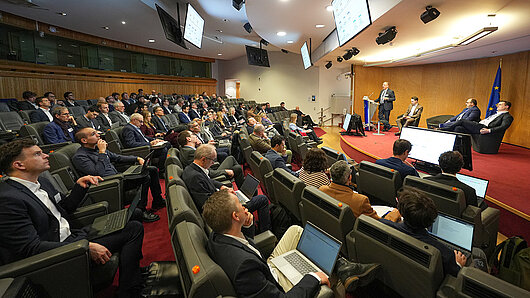
Led by Henna Virkkunen, European Commission Executive Vice-President for Tech Sovereignty, Security, and Democracy, a pre-steering committee composed of high-level representatives of major auto manufacturers and organizations met in late October 2025. The committee defined key strategic priorities for the automotive sector, and agreed to launch four working groups. These working groups will focus on software-defined vehicles, automotive hardware, artificial intelligence and data, and autonomous vehicle development, and officially launched on February 5-6, 2026 at a workshop held in Brussels.
Following a selective application process, HLRS was chosen to join ECAVA and a representative of the center participated in the Brussels conference as a member of the AI Model Development and Data Working Group. HLRS's participation builds on its long history of providing high-performance computing infrastructure and expertise for companies in the automotive sector. As coordinator of the AI Factory HammerHAI, HLRS is also in the process of developing new capabilities that will be highly relevant for the development of next-generation automobile technologies, including the training, fine-tuning, and validation of large-scale AI agents, production of synthetic data using generative AI models and simulations, and benchmarking of candidate foundational models.
HLRS and HammerHAI will bring its expertise in these areas to ECAVA's AI Model Development and Data Working Group. As an ECAVA member, HLRS and HammerHAI will also gain an improved understanding of what manufacturers in the automotive industry need from HPC centers and AI Factories in order to use their resources efficiently. This includes end user requirements with respect to data sharing, data pooling, and foundational AI model development for autonomous vehicles.
In Brussels, the AI Model Development and Data Working Group started productive discussions among stakeholders from across the European auto industry that focused on establishing priorities for collaborations, practical ways to launch collaborations, and how to build links between industry and the AI Factories. Future activities will build on these initial discussions to enable a more robust integration of European AI capabilities into the auto industry.
— Christopher Williams

A member of the Gauss Centre for Supercomputing, HLRS is one of three German national centers for high-performance computing.
