High-Performance Computing Center Stuttgart


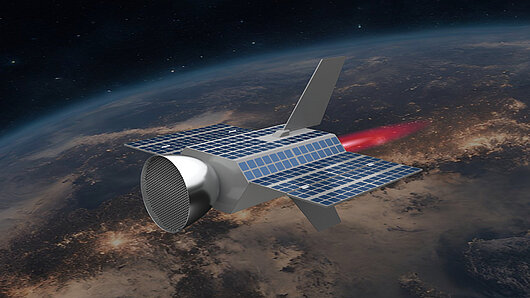
This atmospheric drag is caused mainly by atomic oxygen. These particles continually strike satellites in VLEO, influencing their flight paths, causing surface erosion, and ultimately limiting their operational lifetimes. For this reason, a collaborative research center at the University of Stuttgart called ATLAS (Advancing Technologies for Low-Altitude Satellites) has been conducting fundamental research on interactions between rarefied high‑energy flows and spacecraft surfaces, developing concepts for utilizing the residual atmosphere, and exploring new design and operational strategies that will support improved VLEO satellite design, lifespan, and economic viability.
In one ATLAS subproject, Miklas Schütte of the University of Stuttgart's Institute of Space Systems and Stephen Hocker of its Institute for Functional Matter and Quantum Technologies have been developing a method for better predicting how gas particles and surfaces of satellites interact at very low Earth orbits. "For us at ATLAS, the question is not just how we could optimize aerodynamics to minimize resistance, but how we could use the forces acting on satellites to control their orientation and orbit," Schütte explained. In a recent paper in the journal Physics of Fluids (selected by the journal as an "Editor's Pick") the team describes a new computational approach that models how gas particles reflect off surfaces by considering these interactions at the smallest of scales.
Close to Earth, the aerodynamics of automobiles or airplanes are typically simulated using computational fluid dynamics (CFD), which treats gases as continuous flows. Because the atmosphere at VLEO altitudes verges on the vaccuum of space, however, it is very thin. This means that individual gas particles are located at greater distances from one another and CFD principles do not apply.
Researchers commonly use a method called Direct Simulation Monte Carlo (DSMC) to predict satellite drag in the upper atmosphere. Current DSMC implementations still rely on highly simplified models for gas–surface interactions, though. In most cases, models assume that reflections are either purely mirror-like or purely diffuse, with particles scattering in many directions. Experimental studies, on the other hand, consistently show that the actual distributions of reflected particles deviate significantly from these idealized assumptions.
A much more precise method for simulating particle–surface interactions is molecular dynamics (MD). Based on mathematics that accurately reproduce basic physical principles, MD simulates how molecules interact at the scale of individual atoms over very short periods of time. Achieving this resolution makes molecular dynamics simulations very computationally demanding, and they can only be done using high-performance computing (HPC) systems like those at the High-Performance Computing Center Stuttgart (HLRS).
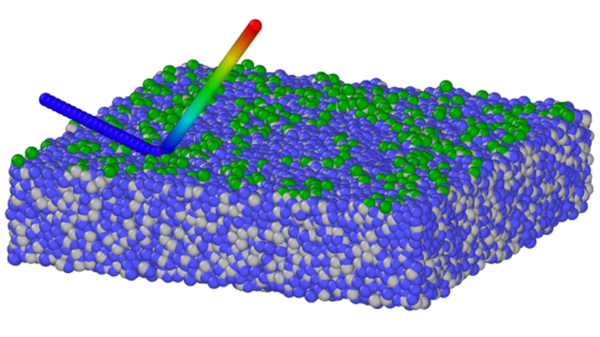
In an ideal world one might use MD simulations to catalog every possible interaction of a gas particle and a surface, but this would be impractical even using today's fastest supercomputers. Moreover, modeling an entire satellite with many surfaces and angles, traveling through space at 8,000 meters per second, would be impossible.
Instead, the ATLAS team used molecular dynamics to support a data-driven, generative machine learning approach. To create their dataset, they used HLRS's Hawk supercomputer to simulate 225,000 particle–surface impacts in VLEO, investigating five different velocity magnitudes each at nine different incident angles. The dataset does not nearly cover all possible interactions, but provides sufficient coverage of a spectrum of potential angles and velocities that would be typical for a satellite traveling in very low Earth orbits. Using 128 cores on Hawk, it took approximately one month to generate the dataset.
Based on the results, the team then trained a machine learning algorithm on the MD data. The resulting model is able to interpolate and extrapolate from the dataset to automatically predict particle reflections for any other situation within the spectrum of the VLEO regime, including particle–surface interactions not specifically simulated using MD. When the investigators checked the resulting model's accuracy they found that its results closely replicate those seen in training and validation data, suggesting that it is much more effective at making reliable predictions than current state-of-the-art models.
Schütte developed this model into a particle scattering kernel that he then integrated into the DSMC simulation method in PICLas. DSMC, in turn, can be used to simulate at a larger scale how rarefied flows (composed of isolated particles and not continuous flows) interact with surfaces in space. "Integrating a scattering kernel into DSMC methods brings these extremely precise simulations of particle reflections at the microscopic level up into the macroscopic or mesoscopic scale that is needed to actually simulate a satellite," Schütte explained.
Schütte says that the successes he and his colleagues have seen so far make it possible to ask new questions that they plan to investigate in more detail within the ATLAS project. For one, they will look more closely at how impacts can lead to the adsorption of atomic oxygen on the satellite surface. Once adsorption has occurred, incoming oxygen atoms can react with the adsorbed species to form molecular oxygen that eventually leaves the surface. At the same time, the impacts can directly erode the surface. A second question concerns the effects of roughness on the scattering of gas particles. The work so far has assumed that surfaces are flat, but it is expected that a more realistic representation of surface topography could produce different results. And finally within the broader ATLAS project, researchers will be able to use the improved models of particle reflection to optimize materials selection for satellite construction, offering better reflection capabilities for controlling spaceflight and orbit stability. In the meantime, Schütte's new scattering kernel is already being used by other scientists within the ATLAS consortium.
Another tantalizing idea would be to collect oxygen molecules in VLEO environments, and use them as fuel in propulsion systems to counteract the effects of drag. The improved model of physical interactions between particles and surfaces provides an important tool for developing this concept. "Having an accurate surface model is a critical step in being able to design an intake that could capture particles in this way," Schütte said. "Right now this is still theoretical, but if it becomes possible it could be a real game changer that would could dramatically reduce the cost and extend the lifecycles of VLEO satellites."
— Christopher Williams
Schütte M, Hocker S, Lipp H, et al. 2025. A machine learning framework for scattering kernel derivation using molecular dynamics data in very low Earth orbit. Phys Fluids. 37: 093609.
Funding for HLRS's Hawk supercomputer was provided by the Baden-Württemberg Ministry for Science, Research, and the Arts and the German Federal Ministry of Research, Technology and Space through the Gauss Centre for Supercomputing (GCS).

A member of the Gauss Centre for Supercomputing, HLRS is one of three German national centers for high-performance computing.
