High-Performance Computing Center Stuttgart


In 20 talks and a poster session, attendees learned about advanced research in fields such as computational fluid dynamics, reactive flows, structural mechanics, physics, computer science, chemistry and materials science, structural mechanics, and physics, among others. The presentations covered science using traditional HPC simulation methods, as well as new approaches that combine traditional simulation using HPC and concepts from machine learning and artificial intelligence. Several presenters also described their experience of porting their codes to Hunter, HLRS's first GPU-accelerated supercomputer. Speakers reported that porting has led to increased performance, and that ongoing work continues to improve the codes further.
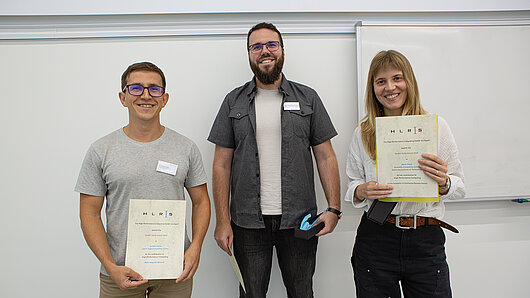
At the conclusion of the meeting, Prof. Dr. Thomas Ludwig, director of the German Climate Computing Center and Chair of the HLRS Steering Committee, announced the winners of the 2026 Golden Spike Awards. Presented every year at the Results and Review Workshop, the awards recognize excellence in computational research and the use of high-performance computing.
Representing their respective projects, this year’s Golden Spike Award winners were:
Dr. Andrey Kotov, Jülich Supercomputing Centre, Forschungszentrum Jülich
Muon Magnetic Moment
Adrian Kummerländer, Institute for Applied and Numerical Mathematics, Karlsruhe Institute of Technology
Lattice Boltzmann Methods for Locally Refined Wall-Modeled Large Eddy Simulations on Heterogeneous High Performance Computers
Dr. Marie Weiel, Scientific Computing Center, Karlsruhe Institute of Technology
On the Scalability of Distributed Random Forests
Conference program, including links to posters presented at the conference
More information about the Golden Spike Awards

A member of the Gauss Centre for Supercomputing, HLRS is one of three German national centers for high-performance computing.
