High-Performance Computing Center Stuttgart


Data analytics for engineering data using machine learning

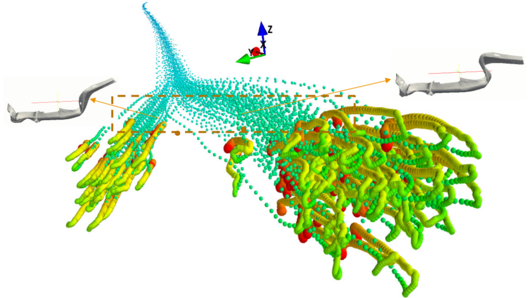
Crash Bifurcation. Source: Victor Rodrigo Iza-Teran, Copyright Fraunhofer SCAI

Fraunhofer SCAI in cooperation with HLRS offers a three-day workshop on data analytics for simulation data using machine learning.

This three-day online workshop addresses the preparation, analysis and interpretation of numerical simulation data by machine learning methods. Besides the introduction of the most important concepts like clustering, dimensionality reduction, visualization and prediction, this course provides several practical hands-on tutorials using the python libraries numpy, scikit-learn and pytorch as well as the SCAI DataViewer.

Learning outcomes

  • Basic knowledge on important machine learning methods to analyze numerical simulation data.
  • Moreover, practical experience in applying these methods.

Target audience

Researchers, developers and industrial end users interested in new ways to analyze and visualize numerical simulation data.

Location

Online course
Organizer: HLRS, University of Stuttgart, Germany

Start date

Apr 20, 2026
08:45

End date

Apr 22, 2026
12:30

Language

English

Entry level

Basic

Course subject areas

Data in HPC / Deep Learning / Machine Learning

Topics

Artificial Intelligence

Big Data

Deep Learning

Machine Learning

Scientific Machine Learning

Back to list

Prerequisites and content levels

Prerequisites
  • Preliminary experience with Python is required. Since Python is used, the following tutorial can be used to learn the syntax.
  • Preliminary experience in using Jupyter Notebook is also required.
Content levels
  • Beginners' level: 4 hours
  • Intermediate level: 5 hours
  • Community level: 5 hours

Learn more about course curricula and content levels.

Instructors

Arno Feiden, Christian Gscheidle and Daniela Steffes-lai (Fraunhofer SCAI)

Agenda

CET times:

Day 1: April 20, 2026

  • 08:45-09:00 Drop in to the videoconference
  • 09:00-12:30 Introduction to machine learning methods like clustering and dimensionality reduction by means of short practical exercises in python
  • 12:30-13:30 Lunch break
  • 13:30-17:00 Application of the methods from the previous session to numerical simulation data stemming from engineering applications with the help of the SCAI DataViewer

Day 2: April 21, 2026

  • 08:45-09:00 Drop in to the videoconference
  • 09:00-12:30 Introduction to prediction by deep learning methods together with hands-on exercises using the software library pyTorch

Day 3: April 22, 2026

  • 08:45-09:00 Drop in to the videoconference
  • 09:00-12:30 Introduction to interpretability of machine learning methods with the help of the examples from the previous session

Handout

Updated exercises and slides will be made available during the course.

Registration information

Register at Fraunhofer SCAI via the button at the top of this page.

Registration closes on Monday, April 6, 2026.

Fees

The course is open and free of charge for participants from academia, industry, and public administration from the Member States (MS) of the EU and EU-associated (Horizon Europe), and PRACE countries.
Only participants from institutions belonging to these countries can take part in this course. The fee will be set to 0€
If you are a member of EXCELLERAT, special conditions are available.

Contact

Junghwa Lee (HLRS), phone 0711 685 87228, training(at)hlrs.de

HLRS Training Collaborations in HPC and AI

HLRS is part of the Gauss Centre for Supercomputing (GCS), together with JSC in Jülich and LRZ in Garching near Munich. EuroCC@GCS is the German National Competence Centre (NCC) for High-Performance Computing. HLRS is also a member of the Baden-Württemberg initiative bwHPC. Since 2025, HLRS coordinates HammerHAI

Acknowledgements

This event is offered as part of HammerHAI, Germany’s first AI Factory, which has a dedicated focus on industry, manufacturing, engineering, and research. HammerHAI provides AI resources and solutions, an upcoming AI-optimized supercomputer, and personalized expert support for AI users at all stages in the AI lifecycle.
This project has received funding from the European High Performance Computing Joint Undertaking under grant agreement No. 101234027. This project is co-funded by the European Commission, the German Federal Ministry of Research, Technology and Space (BMFTR), the Baden-Württemberg Ministry of Science, Research and the Arts, the Bavarian State Ministry of Science and the Arts and the Lower Saxony Ministry of Science and Culture.

EXCELLERAT P2

This course is partly realised in cooperation with the Centre of Excellence EXCELLERAT P2 (funded by the European Union, grant agreement No 101092621). See also the EXCELLERAT Service Portal for more information. 

Further courses

See the training overview and the Supercomputing Academy pages.

Related training
All training

Mar 23 - Apr 17, 2026

Hybrid, Stuttgart

English

Jul 14 - 17, 2026

Stuttgart

English