High-Performance Computing Center Stuttgart


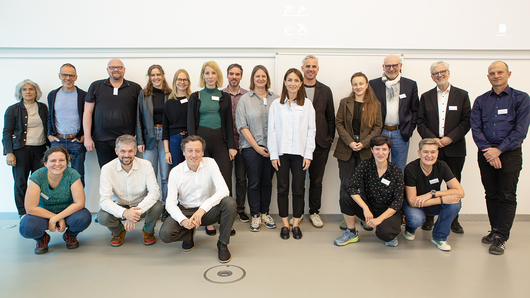
In a recent three-day conference co-organized by the High-Performance Computing Center Stuttgart's program in the Philosophy of Computational Sciences in collaboration with the TU Darmstadt Department of Philosophy and editors from the journal Jahrbuch Technikphilosophie, historians, social scientists, and philosophers analyzed how technology affects democratic processes, as well as how political concepts shape the design and use of novel technologies.
Looking at a wide range of topics — including AI-powered surveillance and decision-making, living laboratories (Reallabore), citizen science, cryptocurrencies, nuclear energy, and radio, among others — participants explored how society negotiates concepts like knowledge, power, legitimacy, and authority in the context of technologically mediated politics.
Digital technologies have opened new possibilities for democracy by increasing participation, transparency, and opporunities for collective decision-making. Its impacts have been far from exclusively positive, however. Several talks at the HLRS conference illuminated why the practice of democracy has become more complex as a result.
According to Nadia Mazouz, Professor of Practical Philosophy at ETH Zürich, we now inhabit the "too late" modern. Something fundamental changed around the end of the 1990s and early 2000s, she argued, when Western society's faith in progress faltered. Replacing it has been a widespread feeling of resignation that things will not improve in the future, a perspective that has also negatively affected public discourse. Digitalization has exacerbated this problem while also creating a fragmented public sphere, making it increasingly difficult for those with differing opinions to reach consensus or compromise. This condition presents a challenge for philosophical ethics of technology, Mazouz explained, as its theoretical foundations are no longer shared across society. For this reason, she argued that ethics needs a better sensitivity to changing social norms and values, lest it be seen as arrogant or irrelevant.
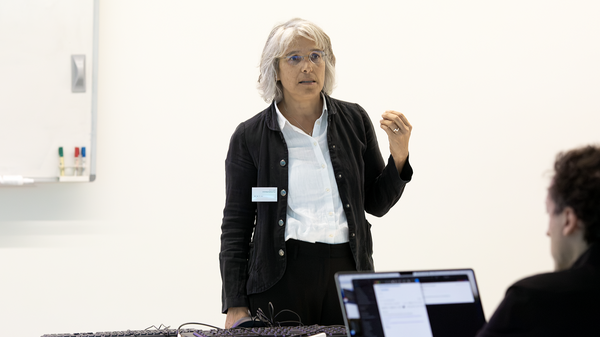
One approach for bridging the gap between policy makers and the general public has been to organize forums for citizen participation in decision making. Sociologist Ortwin Renn of the University of Potsdam and University of Stuttgart is an expert in participatory frameworks, and in his talk he provided an overview of how various formats can help to balance the interests, values, and concerns of citizens in political decision making. He explained how digital tools can lower barriers to public participation while opening a door to the discovery of new ideas. Participatory processes can enable policy makers to gain a better understanding of citizens' needs, and ultimately improve the perceived legitimacy of decisions made at a governmental or institutional level.
Stefan Böschen, Chair in Technology and Society at RWTH Aachen University, suggested that despite these opportunities, the use of digital technologies in the context of participatory decision making, particularly related to science and technology, can have unintended consequences. Digital media and participatory formats such as "Reallabore" create a compulsion for greater numbers of individuals to contribute, he explained. While this can improve democratic engagement, it can also create a false promise of their ultimate influence on how policy decisions are made, increasing skepticism in the general public. At the same time, there is often the expectation that science can provide clear, useful answers. When that doesn't happen, he pointed out, it can damage trust in science-based decision making and the institutions that rely on it.
Providing a historical perspective on the relationship between technology and democracy, Ida Richter of the German Historical Institute of Paris surveyed discussion during the Weimar Republic surrounding the use of radio to broadcast parliamentary debates from the floor of the German Reichstag. Once technicians overcame the technical challenges of live broadcasting, it was thought that radio could supply a technological solution to the problems facing democracy in the 1920s, improving transparency by giving citizens unfiltered access to their leaders' arguments. Some also saw an opportunity in using radio to promote international communication and understanding by broadcasting translations of speeches from other countries. Support for such transparency was not universal among all political parties, however, and some recognized the risk for radio to be used for partisan propaganda, an application that we also see today with digital technologies.
What goals and assumptions determine how technologies are designed, who controls how they function, and how they are used in practice are all questions of power. Several talks at the HLRS conference also analyzed some of the forces at play.
Marcus Düwell, a Professor in the Institute of Philosophy at the Technical University Darmstadt, offered a theoretical context for thinking about the relationship between politics and technology. Drawing on the theory of medieval Italian philosopher Marsilius of Padua, Düwell argued that political philosophy has three requirements: a normative idea of the well ordered society, a concept of political authority, and the legitimization of politics by citizens. Digital technologies must now be considered within this framework, he argued, as the control of technology has come to have direct effects on the practice of politics. Just as normative ideas such as the protection of minorities or the need to address climate change can only be enforced through the exertion of state power, he suggested that state regulation of digital technologies may now be needed to enforce normative concepts that enable democracy to function.
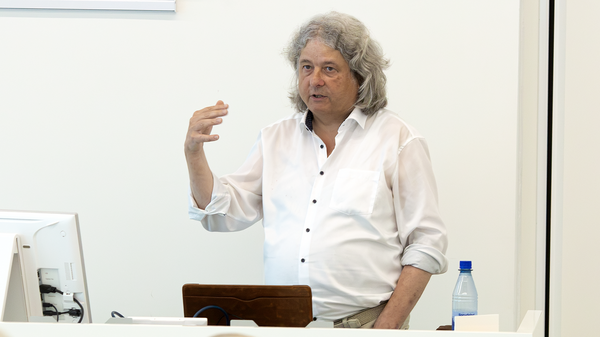
According to Nelly Saibel of the Technical University Dresden, one example of how political ideology can shape technological development can be seen in the rise of cryptocurrencies. In her talk, she showed how cryptocurrencies such as Bitcoin emerged from the cyberpunk movement and Silicon Valley's identification with libertarian political philosophy. This includes interest in the political philosophy of F.A. Hayek, the founder of neoliberal thought. Hayek believed that the centralization of state power over the economy is bound to fail, and argued for a decoupling of currencies from national banks. When cryptocurrency later emerged, it offered a technological solution for this idea, using encryption to evade state control. Saibel argued that as investment in cryptocurrencies has grown, however, the need for capital-intensive server farms for currency "mining" has had a paradoxical effect. Ironically, the maturation of cryptocurrency has moved it away from its original libertarian ideals by reinforcing a new centralization of power — this time, not subject to public oversight within democratic systems.
Another application that demonstrates the intermingling of politics and technology can be seen in Europe's financial investments in artificial intelligence for border control. Anja Breljak of the University of Potsdam focused on the promises of and assumptions behind new digital products that, for example, monitor social media and other online data to support a reduction of migration across Europe's southern borders. Breljak suggested that the idea of border AI is based on a promise that migration could be flawlessly stopped, an idea that also affects how Europe imagines itself with respect to regions to the south and east. At the same time, she said, investment in border AI technologies amplifies a sense of crisis that has its own effects within the European Union, including feeding the rise of nationalist ideologies interested in undermining Europe's liberal tradition from within.
Digital technologies are typically designed to enhance human capabilities. As several talks at the conference revealed, however, they can also exert their own forces in ways that affect individuals and the functioning of democratic systems.
Markus Uhlmann, a socologist at the University of Kassel, discussed the potential use of artificial intelligence for online comment moderation — reducing the spread of disinformation or abusive online discourse, for example. High-quality content moderation currently benefits from professional, human intervention that accepts the need to represent a wide range of opinions while ensuring that visitors feel comfortable and willing to contribute to online discussions. This process is complex, as it can be difficult to interpret whether certain "gray area" comments are acceptable or not, raising the question of whether authority for content moderation can be delegated to a machine. This can be a delicate balance, Uhlmann pointed out, as the perception that an online conversation is being steered can reduce the legitimacy even of well intentioned moderation efforts.

Another case of unanticipated side effects of digital technologies can be seen in a research information system introduced in Austria. As Florian Bettel (University of Applied Arts Vienna) and Aglaja Przyborski (Bertha von Suttner Private University) explained, an online database was created into which all researchers must submit documentation of their academic activities. Although intended as a platform for increasing public transparency about how research funding is used, the speakers explained that it led to competition among researchers for visibility on the platform. For Bettel and Przyborski, this attempt to rationalize scientific review also raises a host of new questions concerning the politics surrounding the value of academic research. What is the real value of the information that the database collects, and for whom? How should the relative importance of different categories of scientific activity be compared? And who is best qualified to judge what counts as impactful research — politicians or researchers themselves?
Over three days, these and other talks prompted lively discussions surrounding philosophical, historical, and social dimensions of the relationship between technology and democracy. The event also highlighted the role of HLRS's program in the Philosophy of Computational Science in facilitating research that seeks to better understand the social and cultural context and impacts of advanced digital technologies.
Conference proceedings gathering papers presented at the meeting will be published in an upcoming volume of the Jahrbuch Technikphilosophie.
— Christopher Williams

A member of the Gauss Centre for Supercomputing, HLRS is one of three German national centers for high-performance computing.
