High-Performance Computing Center Stuttgart

Hackathon: Porting and Optimization for Hunter and Herder

Participation in English or German is possible.
Learn how to optimize your program for HLRS's system Hunter and prepare for Herder.

The Hackathon consists of two parts

  • a preparation phase with a discussion of your project and goals for the hackathon, taking place April 12 (online),

  • the actual coding phase, in which you will work towards the defined goal, e.g. profile and improve performance of your code, taking place April 26 - 30 (hybrid).

HLRS's current APU based supercomputer system called “Hunter” is available since 2025 and “Herder” is expected later in 2027. As for every new system, users have to spend some effort into porting their code and workflow to the new environment, in particular since compilers and tools on Herder will differ from Hunter (CPE reaches end of life, AMD compilers and tools must be used). Furthermore, the vast majority of Hunter’s and Herder's compute power will be delivered by the GPU cores, which requires users to adapt their hot loops in order to offload them to the GPUs and optimize for discrete GPUs on Herder. In this hackathon we will hence support our users in doing both. This hackathon focuses on traditional scientific codes but also dedicates time to users running part or all of their workflows with AI.

If you are new to working on HPC systems or Hunter, our Introduction to Supercomputing on Hunter course covers the essentials. For GPU offloading, multiple programming models (HIP, OpenMP device offloading, PSTL/do concurrent) are available depending on the programming language used. If you are unfamiliar with them, please have a look at the recordings in the self-study corner or join one of our courses, e.g. AMD Instinct™ GPU Training. In the preparation phase, pros and cons of those models based on your situation could be discussed if you are just starting porting, and you and the support staff will decide together what are suitable goals for the coding phase and how to proceed.

In the coding phase, you will work towards your defined goals supported by HLRS, HPE and AMD user support staff. So, most probably you will be porting and optimizing your code for the new system, i.e. building with suitable compilers, using performance analysis tools to identify 'hot loops' and offloading them to the GPU, or to tune already offloaded loops, tune inter-node communication (MPI) or profile and improve how you read and write data from and to the parallel filesystem.

Due to the large number of groups using HLRS’ systems but limited support staff, the number of participants needs unfortunately to be limited. In order to use the system as efficiently as possible, we have to focus on groups holding medium and large compute time budgets. We hence reserve the right to select attendees!

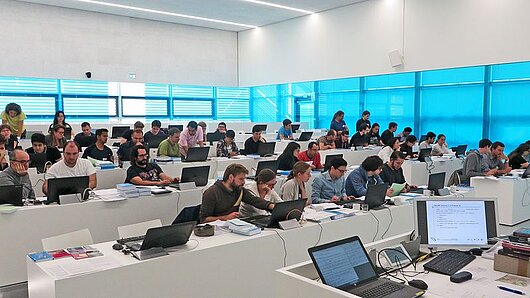
To allow for easy attendance, we decided to provide this workshop in a hybrid fashion. Besides meeting in person at HLRS, we will also setup breakout rooms in a video call to enable remote participants to communicate as well as share screen with support staff, hence providing the same options of interaction as meeting in person.

Target audience: Groups holding a compute time budget to be used on Hunter.

Location

This hybrid event will take place online and at
HLRS, University of Stuttgart
Nobelstraße 19
70569 Stuttgart, Germany
Location and nearby accommodations

Start date

Apr 12, 2027
09:00

End date

Apr 30, 2027
13:00

Language

English

Entry level

Advanced

Course subject areas

Bootcamp/Hackathon

Hardware Accelerators

Performance Optimization & Debugging

Topics

Debugging

Artificial Intelligence

Big Data

Code Optimization

Deep Learning

GPU Programming

MPI

MPI+OpenMP

OpenACC

OpenMP

Back to list

Prerequisites

Prerequisites

To participate in the Hackathon, you should already have an account on Hunter and make sure to be able to access Hunter from the place you plan to work, e.g. via VPN. Please check with your PI if you are unsure if VPN access is enabled for your account. See https://kb.hlrs.de/platforms/index.php/VPN for how to set up VPN.

  • Furthermore, kindly provide the following details by submitting an email to training(at)hlrs.de and CC to Björn Dick: dick(at)hlrs.de by the workshop registration deadline.
    • Scientific domain you are working in,
    • name of your code including URL (if available),
    • Numerical approaches (should not be the majority of the provided details),
    • name of the compute time budget used,
    • programming language,
    • programming models used (MPI, OpenMP, etc.),
    • list of dependencies/libraries,
    • known issues with specific compilers
    • information on porting efforts done so far
    • IO requirements (what is written to disk? with which frequency? number of files generated per each of those I/O events? volume of those files?)
    • Size of your test case in terms of number of Hunter nodes used as well as expected runtime.
  • Running AI codes also necessitates information about:
    • The user's AI software stack.
    • IO requirements (e.g., dataset size, number of files, model size, number of checkpoints)
    • The workflow along with computational requirements (e.g., number of GPUs needed for model training/fine-tuning and hyperparameter tuning).
  • Additionally, we require that you bring your own code including a test case which is set up according to the following rules:
  • use case selection:
    • When processing the test case, your code should have a behavior and profile which is as close as possible to that of current and future production runs.
    • If possible, the test case should be representative for those production runs of your group which consume the largest part of your compute time budget.
  • number of GPUs:
    • In order to be representative, the test case should be in size comparable to the respective current and future production runs.
    • In order to save valuable resources and to allow for a productive workflow, it should, however, be as small as possible.
    • So, please, be prepared to reduce the size of your test case during the workshop! This can often be achieved while staying representative by reducing the simulated domain or resolution and keep the computational load per GPU constant ("weak down scaling").
  • wall time:
    • In order to allow for a productive workflow, the wall time should be a few minutes only.
    • At the same time, it should cover all important parts of the code, i.e. computation, communication and I/O.
    • So take into account to reduce the number of simulated time steps and be prepared to increase I/O frequency to render investigation of I/O possible within such a low number of timesteps.

Please have in mind that it's possible to bring multiple test cases with you. This allows to cover different use cases and figure out hotspots with a production-alike sized case while doing the porting on a smaller case which allows for a simplified workflow.


If you are unsure about how to set up your test case, please contact Björn Dick (see contact data below).

In general the language of instruction is German, but can be changed to English if required.

Instructors

HLRS, HPE and AMD user support staff

Learning outcomes

  • Knowledge about and practical experience with deploying your code in using AMD tool chain.
  • Important knowledge about how to port hot loops, gather and interpret relevant performance metrics, and how to optimize your code for GPUs.

Agenda

- preliminary -

Local times: Central European Time Zone (Berlin).
Communication format: Face-to-face, via chat, video call, and email.

Preparation Phase (virtual event)

April 12, 9-17 h
  • Tutor assignment
  • Development of agenda for your code
  • Develop to-dos (Compile & Profile)
  • Set up of test case together with tutors
  • Agree on checkpoints with tutors until the hackathon starts

Coding Phase (hybrid event)

The second phase will be offered as a hybrid event. Please select for the hybrid event on which days you plan to be on-site at HLRS when you apply.

April 26 - 30, 8:45-9:00 (Monday opening at 12:45 to facilitate travelling to Stuttgart)Local registration/drop in to Zoom
April 26 - 30, 9:00-17:30 (Monday opening at 13:00 and Friday closing at 13:00 to facilitate travelling to/from Stuttgart)Working on your code and workflow together with HLRS/HPE/AMD support staff

We expect you to participate in both phases, in the first at least to discuss your project and goals.

If you need a recap on APUs/GPUs, OpenMP target offload, or AMD tools, self-study materials are available or you can join one of our training courses.

Hybrid course

This course will be hybrid, i.e. it will take place at HLRS on-site, but it will also be possible to attend remotely. Participants, remote as well as on-site, have to be aware and agree that they might appear in the live video stream taken by a camera in the back of the lecture room or by a webcam on laptops. The live stream will not be saved. We strongly recommend to attend this course on-site since on-site attendance is much more effective and efficient in our experience. Therefore we might give priority to on-site over remote participants during registration.

Registration information

Apply for this course via the button at the top of this page (will be available soon).

Please submit information about your code, see section Prerequisites, as soon as you applied for the workshop via email. You can book individual days according to your and your project's needs, attending a full workshop in this case is not necessary.

Please apply by April 10, 2027.

Fees

  • Students without master’s degree or equivalent at a German university: 0 Euro
  • PhD students or employees at a German university or public research institute: 0 Euro

Further fee categories can be found in the registration page.

Our course fees include coffee breaks (in classroom courses only).

Contact

Björn Dick phone 0711 - 685 87189, bjoern.dick(at)hlrs.de
Tobias Haas phone 0711 685 87223, training(at)hlrs.de

HLRS Training Collaborations in HPC and AI

HLRS is part of the Gauss Centre for Supercomputing (GCS), together with JSC in Jülich and LRZ in Garching near Munich. SIDE is the German National Competence Centre (NCC) for High-Performance Computing. HLRS is also a member of the Baden-Württemberg initiative bwHPC. 
Since 2025, HLRS has been coordinating one of the AI Factories of the EuroHPC JU: HammerHAI. 

Further courses

See the training overview and the Supercomputing Academy pages.

Related training
All training

Jan 18 - Feb 05, 2027

Online (flexible)

English

Jan 19 - 21, 2027

Hybrid, Stuttgart

English

Feb 24, 2027

multisite

English

Mar 15 - 19, 2027

Dresden

English

Apr 13 - 16, 2027

Online

English

May 31 - Jun 01, 2027

Online

English