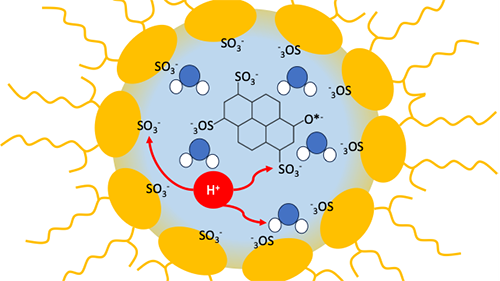
What if the familiar rules of water chemistry break down inside the tiny pockets of a living cell? A team at the University of Duisburg-Essen used the Hawk supercomputer at HLRS Stuttgart to track single protons inside reverse micelles — water droplets just a few nanometres across that mimic the confined environments found in enzymes, fuel-cell membranes and catalysts. The simulations reveal that confinement changes the rules: a proton can stick to the surfactant walls of the droplet, something that does not happen in ordinary bulk water, opening competing pathways that may explain why nature so often does its chemistry in tight spaces.
Read the complete user research report at the Gauss Centre for Supercomputing.
Principal Investigator
Dr. Ana Vila Verde
Universität Duisburg-Essen