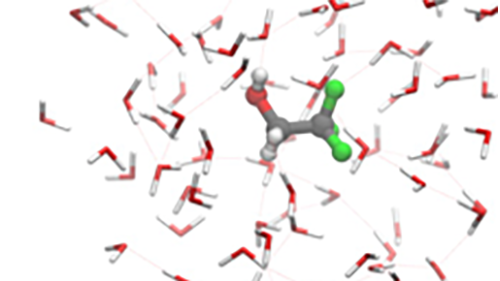
Roughly one in three new medicines contains fluorine — yet science still cannot fully explain why swapping hydrogen for fluorine in a molecule makes it shun water so strongly. A team at the University of Duisburg-Essen, led by Dr. Ana Vila Verde, used the Hawk supercomputer at HLRS Stuttgart to simulate, atom by atom, how water rearranges itself around fluorinated and non-fluorinated cousins of common solvents. The first results overturn a long-standing assumption: simple gases such as methane are not, in fact, reliable miniature models for understanding fluorine’s water-repelling effect in tomorrow’s drugs and materials.
Read the complete user research report at the Gauss Centre for Supercomputing.
Principal Investigator
Dr. Ana Vila Verde
Universität Duisburg-Essen