High-Performance Computing Center Stuttgart


List of HLRS Research Projects


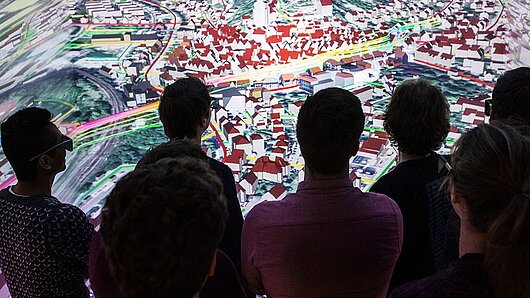
Reallabor Stadtquartiere 4.0

The project Reallabor Stadtquartiere 4.0 explored new methods and technologies to support participatory planning for sustainable development.

Photo of people observing 3D visualization showing aerial view of downtown Herrenberg.

BEAM-ME

BEAM-ME developed strategies based in applied mathematics and computer science to increase computational performance of energy system models on high-performance computing systems.


PHANTOM

The project aims to address the challenges of energy-efficient parallel infrastructure development based on acceleratable heterogeneous hardware such as GPU, CPU, and FPGA in domains like cyber-physical systems, Internet of Things, or high-performance computing.


Fortissimo 2

The FORTISSIMO 2 project targets the adoption of advanced simulation in small and medium-sized companies, realizing a “one-stop-shop” to enable state-of-the-art hardware access, expertise, applications, visualization and tools in an efficient fashion.


POP

This Centre of Excellence in Computing Applications offers the service of precisely assessing the performance of computing applications, identifying issues that affect code performance and the best way to alleviate them.


CoeGSS

CoeGSS brings together the power of high-performance computing and some of the most promising thinking on global systems in order to improve decision-making in business, politics and civil society.


ExaFLOW

The main goal of ExaFLOW is to address key algorithmic challenges in CFD (Computational Fluid Dynamics) to enable simulation at exascale, guided by a number of use cases of industrial relevance, and to provide open-source pilot implementations.


Mont-Blanc 3

The Mont-Blanc project aims to design a new type of computer architecture capable of setting future HPC standards, built from energy-efficient solutions used in embedded and mobile devices.


Sustainability in HPC Centers

Motivated by the sustainability strategy, green IT strategy, and HPC strategy of the state of Baden-Württemberg, this project investigated how such principles could be applied to the High-Performance Computing Center Stuttgart (HLRS).


Fortissimo

The importance of advanced simulation to the competitiveness of both large and small companies is well established. The principal objective of Fortissimo is to enable European manufacturing, particularly small to medium enterprises (SMEs), to benefit from the efficiency and competitive advantage inherent in the use of simulation.


bwHPC-C5

The project bwHPC-C5 coordinated support on a federated basis for users of high performance computing (HPC) in the state of Baden-Württemberg and implemented related measures and activities.

Logo for bwHPC-C5 Project.

DASH

DASH aims to ease the efficient programming of future supercomputing systems for data-intensive applications. These systems will be characterized by their extreme scale and a multi-level hierarchical organization.