High-Performance Computing Center Stuttgart


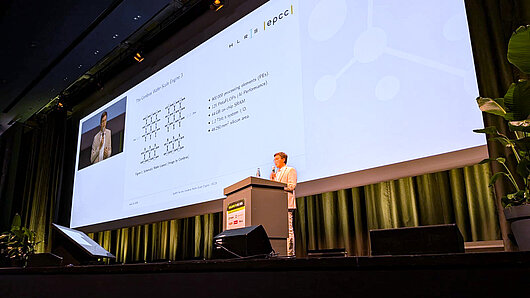
In today's current generation of high-performance computing systems, processors that were originally used for artificial intelligence applications have increasingly been repurposed to accelerate traditional simulation workloads, enable hybrid workflows that combine simulation and data-driven methods, and run data-intensive tasks that can be managed faster on AI-optimized processors. Renschler, Schäfer and his colleagues wanted to understand whether the WSE could also be used in this way.
In their tests they focused on SpMV, a computational method that is commonly used in classical applications for simulation such as finite element analysis and computational fluid dynamics. Renschler and Schäfer used the Wafer-Scale Engine to accelerate a highly parallelized component of a typical simulation workflow that includes this method. They also performed weak- and strong-scaling experiments, revealing bottlenecks that affected application performance. This enabled the investigators to suggest optimization strategies that could improve performance of SpMV methods on the WSE in the future.
The research was conducted within the context of the HLRS Future Computing Group, led by Dr. Johannes Gebert, a multidisciplinary research team within HLRS that tests and evaluates emerging hardware concepts and their suitability for typical high-performance computing applications.
Renschler, Schäfer and Gebert conducted this experiment together with Mark Parsons, director of EPCC in Edinburgh.
— Christopher Williams

A member of the Gauss Centre for Supercomputing, HLRS is one of three German national centers for high-performance computing.
